
Science, Skepticism, and the Courage to Claim Your Magic with Sabrina Scott, The Witch in the Grey Area (I'm On The Grey Area Unfiltered Podcast!)
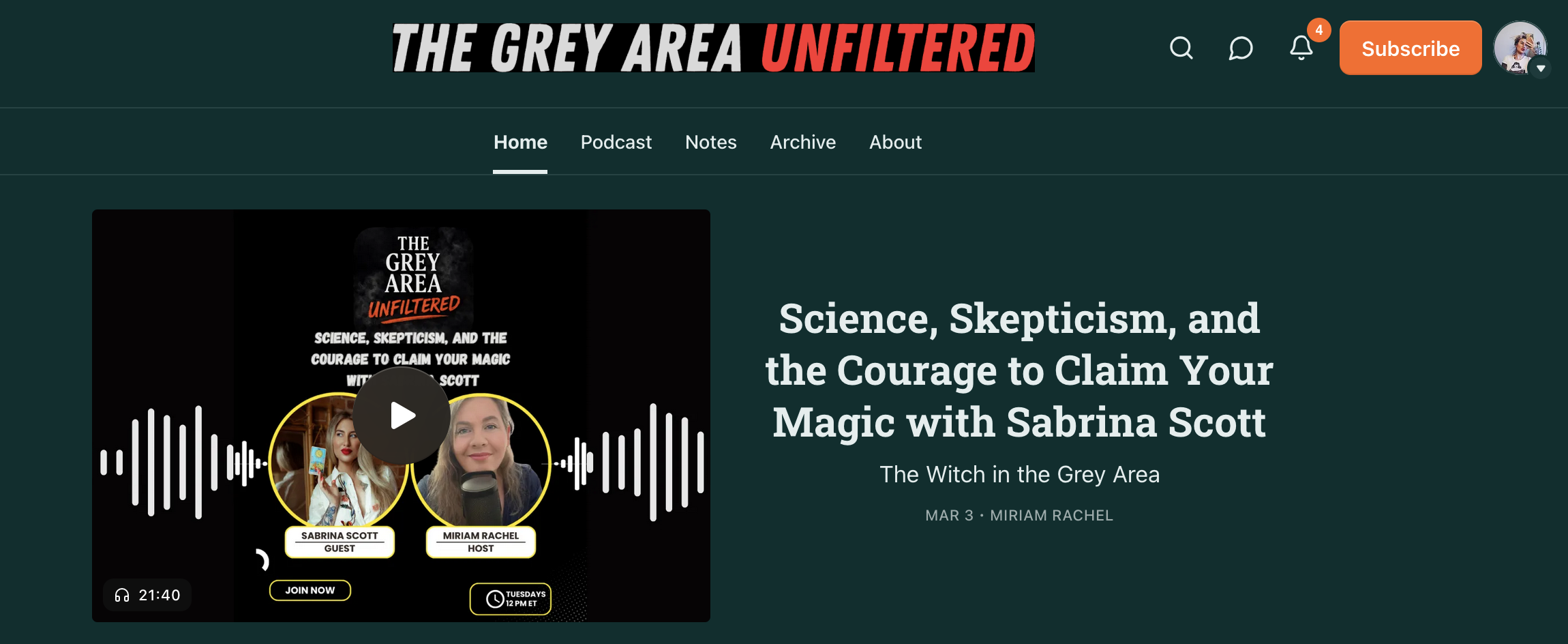
A new episode of The Grey Area Unfiltered is out, featuring yours truly!
Here is an excerpt from what Miriam, the host of this podcast, wrote about our chat together:
Science and Witchcraft: Enemies or Estranged Cousins?
We’ve been taught to see things in black and white.
Science = rational, based on evidence, and measurable.
Witchcraft = mystical, symbolic, and irrational.
But is that really a fair comparison?
Science is a method, while witchcraft, in many modern forms, offers a way to connect with meaning, intention, and our own minds.
When Sabrina talks about magic, she’s not usually trying to break the laws of physics. It’s more about focusing attention, intention, and energy in specific ways. When you take away the flashy bits, what do you really get? The answer is:
Focused thinking.
Emotional healing.
Changing habits.
Balancing our nervous system.
There’s a lot of research on the psychology of rituals. They help reduce anxiety, boost our sense of control, and bring order to chaos. Even athletes do ritual-like behaviors before games—not because they change physical laws, but because they can shift their mindset.
Is that just a placebo? Maybe. But a placebo isn’t something to brush off. It shows how powerful our minds can be in affecting our bodies.
And here’s where it gets tricky: If a structured ritual helps someone deal with trauma, make brave choices, or manage fear—does it really matter if the process is metaphysical or purely psychological? Or are we just creating a false divide?
The Psychology of Ritual: Placebo, Power, or Something Deeper?
We often throw around the word “placebo” when we want to brush something off. But the truth is, placebo effects can actually lead to noticeable changes in our bodies—like shifting hormones, reducing pain, or even modulating our immune responses.
So what’s the deal when someone does a spell for things like protection, closure, abundance, or letting go? On the one hand, it looks like a symbolic performance. On the other hand, it’s all about how our brains really work.
When you light a candle with a purpose, write down a name and burn it, or bury something to symbolize moving on, your brain doesn’t make a clear distinction between symbols and real experiences, like we usually think. Rituals give meaning to our actions, and those actions affect what we believe. When our beliefs shift, our behaviors change, and that can lead to different outcomes.
And you don’t need anything supernatural for that to hold power.
But here’s where Sabrina takes it a step further. She doesn’t just see magic as a way to cope psychologically—she leaves room for the mysterious side of things. That’s the part that can make skeptics uneasy.
Spirits, Deities, Ancestors: Belief vs. Evidence
Can spirits be measured? Nope. Does that mean we should stop talking about it? Not really. People have been honoring their ancestors and calling on deities in different cultures for ages. It’s one of those things that seems to be a common thread in human history.
So, are these traditions just made-up nonsense? Or are they actually tapping into some real psychological stuff in a symbolic way? When we think about ancestors, they can serve a bunch of purposes:
Keeping memories alive across generations
Linking cultures through time
Making us feel accountable for our actions
Grounding our identity
But some folks believe the experience is more than just a symbol. And that’s where things get interesting.
You can say:
“I don’t have solid proof of spirits.”
And also say:
“I find meaning and guidance through this way of thinking.”
Science usually looks for things that can be measured and repeated. Spiritual experiences are often personal and can’t be easily replicated.
That doesn’t make them fake — it just means they’re tricky to label. Most people today dislike uncertainty. But it’s in that uncertainty where real depth can be found.
Check out Miriam’s substack here, where she talks more about our episode together and read the rest of what she has to say about the topics we discussed: https://thegreyareaunfiltered.substack.com/p/science-skepticism-and-the-courage